We have recently witnessed a paradigm shift in the educational system. We all stopped using traditional classrooms in favour of online resources. Teachers and parents can use Bloom’s digital taxonomy to assess students’ knowledge and determine what they can reasonably expect to learn next. The specific learning needs of a child can then be addressed. In this article, we’ll look at how Bloom’s Taxonomy can be applied to online teaching.
What is Bloom’s Taxonomy?
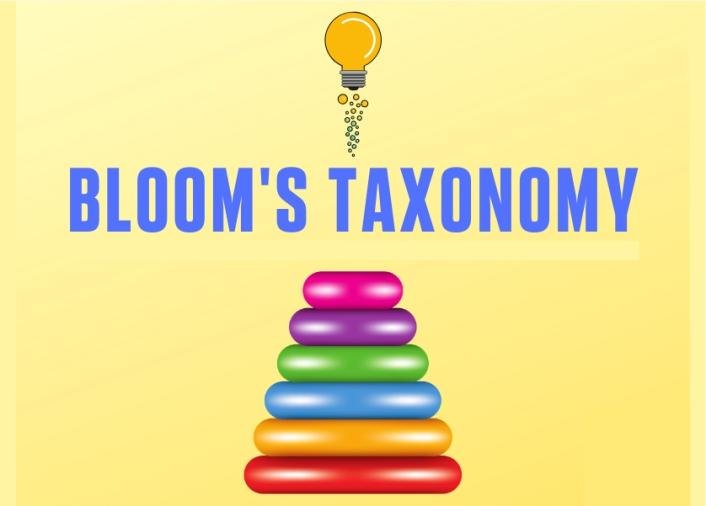
The term “taxonomy” refers to a method of organisation. Therefore, Bloom’s taxonomy is a hierarchical framework for organising educational goals. Bloom’s taxonomy is a model for categorising thought according to the degree of mental exertion required. In the 1950s, educational psychologist Benjamin Bloom developed a model to analyse and assess student progress. The primary goal is to influence how students approach their education.
Learning, according to Bloom’s Taxonomy, consists of Six Levels or Goals:
Remembering: Retrieving, recognizing, and recalling relevant knowledge from long‐term memory.
Understanding: Constructing meaning from oral, written, and graphic messages through interpreting, exemplifying, classifying, summarizing, inferring, comparing, and explaining.
Applying: Carrying out or using a procedure for executing, or implementing.
Analyzing: Breaking material into constituent parts, determining how the parts relate to one another and to an overall structure or purpose through differentiating, organizing, and attributing.
Evaluating: Making judgments based on criteria and standards through checking and critiquing.
Creating: Putting elements together to form a coherent or functional whole; reorganizing elements into a new pattern or structure through generating, planning, or producing.
In the digital age, what is Bloom’s taxonomy?
Andrew Churches developed a digital version of Bloom’s taxonomy in 2008 to establish a hierarchy of online learning activities. It acknowledges the importance of a technology-enhanced learning strategy and the potential of digital tools to improve classroom instruction.
The primary goal of digital taxonomy is the holistic development of students’ cognitive, affective, and psychomotor skills.
Bloom’s Taxonomy’s Function in Today’s World of Electronics
One of the most important aspects of e-learning is the development of genuine educational opportunities for kids. Our young children need to be intrinsically motivated through rich learning experiences. To aid education, we implement Bloom’s digital taxonomy. In this framework, digital tools are integrated into conventional pedagogical methods.
Our kids might benefit from a deeper understanding of Bloom’s taxonomy if we apply it to their education. By using this taxonomy, teachers and parents can help children focus on the skills that will help them become more creative and resourceful problem solvers. It’s a major factor in creating kid-centric classroom settings.
In sum, using Bloom’s Digital Taxonomy as a guide, educators can create activities and tests that push students beyond memorization and into higher-level thinking (such as research). Parents can better encourage the growth of their children’s lower- and higher-order thinking skills if they have a firm grasp of this taxonomy. The primary focus is on encouraging kids to think critically and solve problems. They will benefit academically and professionally from developing their proficiency in these areas.