
The hard mornings.
Some days a child cries at the door for a week. We don’t distract them while you slip out — that makes tomorrow worse. We say goodbye properly and stay with them through it.

It’s the question every parent asks, and most preschools answer with a list of facilities. Here’s the honest version instead: hour by hour, for three different children, on an ordinary Tuesday.
Because a child of three cannot tell you.
You’ll ask what they did and they’ll say “playing,” or “nothing,” or occasionally something so specific and strange that you’re no closer to knowing.
So rather than describing our philosophy again, here’s the day itself. Nothing on this page is a showcase day. There’s a spilled snack, a child who doesn’t want to join in, and a nap that runs over.
9:00 to 11:30 · 2 hours 30 minutes
He’s fine at the door today. Yesterday he wasn’t. His teacher crouches down with the monkey puppet, says his name, and takes his bag — which settles the matter.
The national anthem. Two-year-olds stand for it, mostly. One sits down halfway and is gently stood back up.
Ten minutes, which is about the ceiling at this age. A hello song using every child’s name, and the weather.
A picture book with a repeated line the children can shout along to. He waits for his line. He shouts it.
Big and small, using real things: a big ball, a small ball, a big shoe, his shoe.
He opens his own box. It takes a while. Nobody opens it for him.
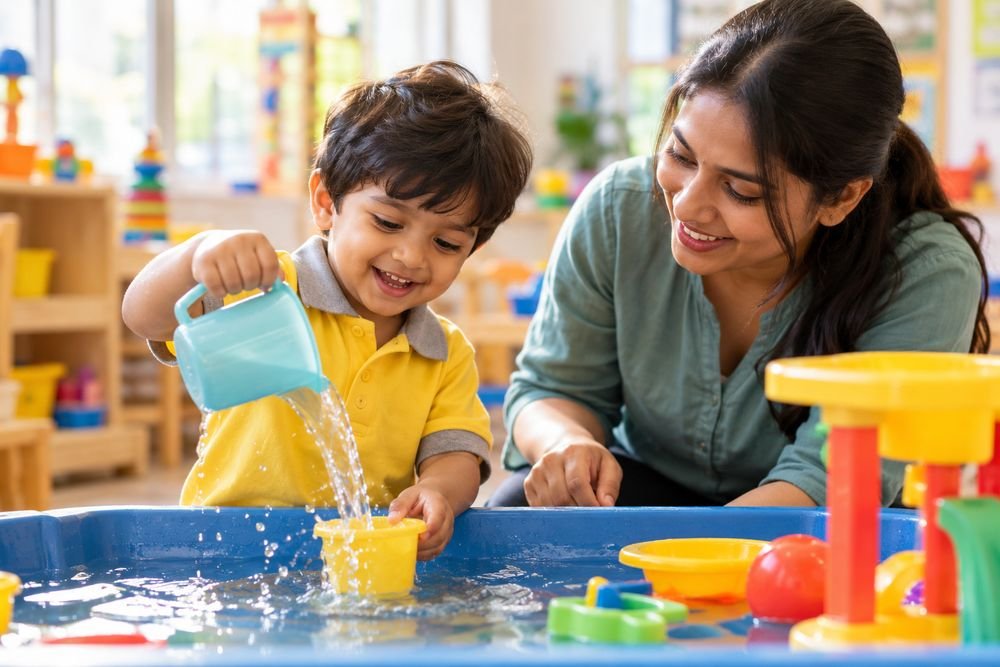
Counting ducks into the water tray. One, two, lots. An adult narrates: pour, full, empty, splash. He repeats “splash.”
The same three rhymes as yesterday, with actions. Repetition is how the language embeds.
Blocks, puzzles and stacking rings with a friend. There’s a small dispute about the rings. His teacher waits, then offers the words: “Can I have a turn next?”
Finger painting. Mostly on the paper.
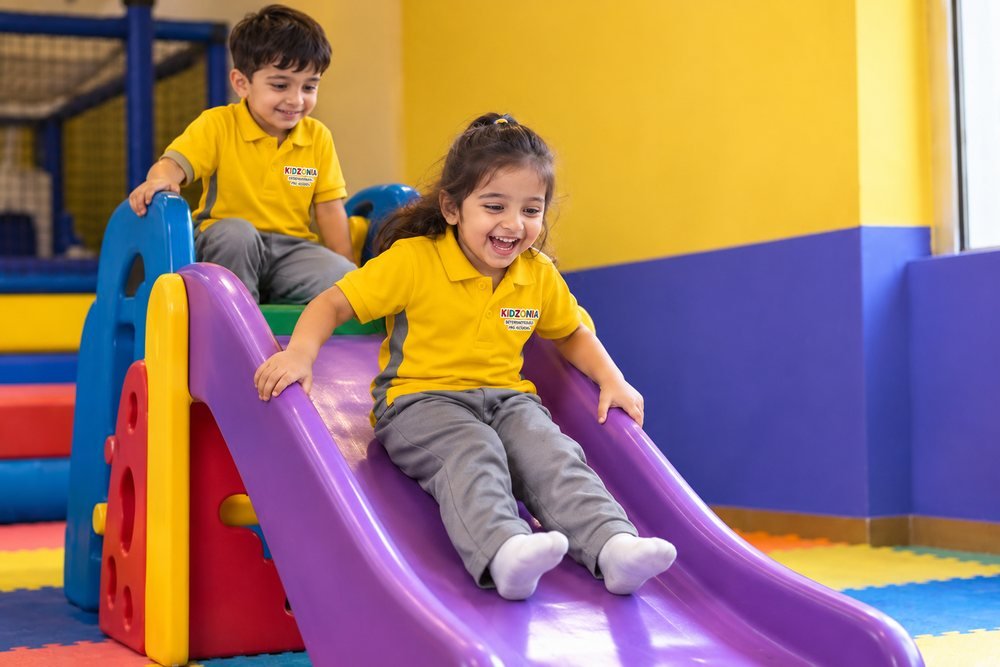
The slide, the tunnel, and a wheeled thing he refuses to give up.
Hands washed, bag found, shoes on — the wrong feet, but by himself.
He tells you nothing. He is, however, extremely tired.
Times follow our standard daily plan. Your centre will confirm exact session times.
9:00 to 12:00 · 3 hours

A hello at the door and a short activity waiting on her table: matching lowercase letters to pictures. Starting with intent, rather than drifting.
The national anthem, standing properly now, and one thing that happened at home yesterday that she’d like everyone to know about.
The month’s theme is the market. Yesterday they made a shop. Today they’re deciding what things cost, which turns into a longer argument about money than anyone anticipated.
Phonics through sound games. Today’s sound is sh. They hunt the room for things that start with it. Meera finds a shoe, a shell and — after some debate — a shadow.
Why do some things in the shop cost more than others? Heavier, bigger, rarer. A real question, taken seriously.
Snack, opened and finished by herself, with a conversation about what everyone brought.
Sorting the shop’s stock by size, then counting into groups of five. Real objects, in her hands.
A counting rhyme that happens to be about a market. This is not a coincidence.
Group play at the shop. A game with rules, which collapses twice over fairness and gets rebuilt both times. This is the social curriculum, and it’s largely invisible.
The shop needs a sign, in English and in Hindi. Yesterday’s sign is still there, which is the point — she’s returning to something she started.
Outdoors: running, balancing, and a race she insists was a draw.
Wash up, pack up, and a quick look back: what did we do, what surprised us, what’s next.
She reports that she made a shop. This time you have some idea what that involved.
Times follow our standard daily plan. Your centre will confirm exact session times.
9:00 to 12:00 · 3 hours

He walks in on his own now, puts his bag in his cubby and tells his teacher one thing that happened at home. Some days it’s a lot more than one thing.
The national anthem, standing still all the way through. A year ago this was harder than it looks.
Today’s question is about the week’s theme, transport. Kabir has opinions about trains, and gets to share them, and then has to listen to everyone else’s.
Reading short words and simple sentences from the board, then writing two of his own. Spelling is creative. Letter formation is getting there.
Why do heavy ships float? A tub of water, a lump of clay and a clay boat. The boat floats, the lump sinks, and the room goes quiet for a moment.
Snack, opened and finished by himself, and the box closed and put away without anyone asking.
Adding and taking away with counters, then writing the sums down. Two-digit numbers, a number line, and a lot of checking his friend’s answers.
A rhyme in English and one in Hindi, both about wheels.
Building a bus station in small groups. Someone has to be in charge of tickets, which takes some negotiating.
Hindi letters and simple words, and a sign for the bus station written in both languages.
Outdoors: hopping, skipping, catching, and a relay race with rules he explains to everyone.
Wash up, pack up, and a look back at the morning: what did we learn, what was hard, what’s next.
He tells you boats float because of their shape. He’s right. Next year, big school.
Times follow our standard daily plan. Your centre will confirm exact session times.